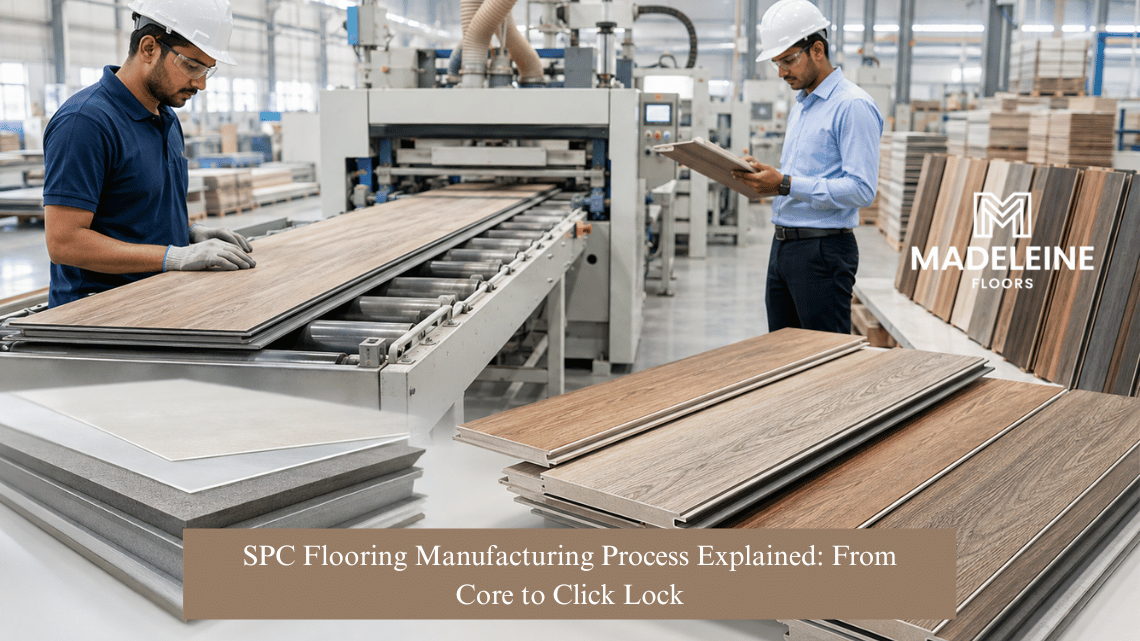
SPC Flooring Manufacturing Process Explained: From Core to Click Lock
The popularity of SPC flooring in India is increasing rapidly. From residences to offices, shops to hotels, hospitals to clinics, it has all the characteristics that make it highly desirable for various purposes.
But most buyers never really ask how this flooring is made. If you understand the process, spotting a good product becomes a lot easier. It also helps you pick trustworthy SPC flooring manufacturers in Gujarat, instead of relying purely on a showroom pitch.
In this guide, you will discover every step involved in the production of SPC flooring, from the core to click lock. Also, we will discuss factors that influence product quality as well as how to spot a good product before purchasing it.
What is SPC Flooring?
SPC stands for Stone Plastic Composite, sometimes called Stone Polymer Composite. It’s a rigid type of vinyl flooring built around limestone powder, PVC resin, and a few stabilising agents.
SPC is a solid core, which is why you get that stability under your feet that you don’t get with soft vinyl.
A typical SPC plank is made up of:
- UV coating
- Wear layer
- Printed design film
- Rigid SPC core
- Underlayment (optional)
Each of these layers has its own job, and together they decide how the final floor performs.
SPC Flooring Manufacturing Process Explained
1. Raw Material Selection
Everything begins here. Manufacturers source:
- Limestone powder
- Virgin PVC resin
- Stabilisers
- Lubricants
- Pigments
- Processing additives
The quality of these inputs decides almost everything down the line: strength, water resistance, finish, and how long the floor actually lasts.
2. Mixing the Materials
Once sourced, the materials go into industrial mixers. The goal is simple: a clean, uniform blend with no moisture or impurities.
Proper mixing will provide you with:
- Perfect density
- High strength
- Smooth surface
- Uniform colour
Even a little mistake in mixing can ruin the whole batch.
3. Extrusion of the SPC Core
This is really where SPC flooring is “born”. The mixed compound is pushed through an extrusion machine under heat and pressure.
At this point:
- Heat melts the material
- Pressure increases density
- Rollers control thickness
- Cooling stabilises the sheet
This produces a stiff core that retains its shape despite Indian summers and monsoons.
4. Decorative Film Lamination
Next, a printed design film gets laminated onto the core. This is purely about looks, but it matters a lot, since this is what you actually see every day.
Common finishes include:
- Oak wood
- Walnut
- Teak
- Marble
- Concrete
- Stone texture
Printing technology has improved so much that many of these designs are hard to tell apart from real wood or stone unless you look closely.
5. Applying the Wear Layer
A transparent wear layer sits above the design film. This is your floor’s daily shield protecting it from scratches, stains, and general footfall.
- Homes: 0.3 mm usually works
- Commercial spaces: 0.5mm or more
A thin wear layer might look fine on day one but won’t hold up in a busy office or shop.
6. UV Surface Coating
On top of the wear layer comes a UV-cured coating. This process:
- Prevents fading
- Reduces staining
- Provides scratch resistance
- Facilitates cleaning
This is a thin coating that goes unnoticed while doing a great deal over the years.
7. Precision Cutting
The finished SPC sheets are cut into planks using CNC machines. Precision here means:
- Perfect fitting
- Easy installation
- Minimal gaps
- Clean finish
Sloppy cutting is one of the most common reasons floors look uneven after installation, even when the material itself was decent.
How the Click Lock System is Manufactured
Precision Milling
This is the step that makes SPC flooring so easy to install. Specialised milling machines carve interlocking edges onto every single plank.
The tolerance here is extremely tight; even a hair’s width off, and planks won’t click together properly.
Quality Testing of Click Lock
Before any plank leaves the factory, batches are checked for:
- Locking strength
- Gap resistance
- Joint durability
- Repeat-fit performance
A well-made click lock means faster installation and a floor that stays tight instead of shifting or gapping later.
Quality Control Throughout Manufacturing
Good manufacturers test at every single stage, not just at the end. Typical checks include:
- Thickness check
- Density test
- Wear resistance
- Water resistance
- Fire resistance
- Dimensional stability
- Impact resistance
- Scratch test
This is what separates a floor that lasts fifteen years from one that starts complaining within two.
Why Manufacturing Quality Matters
A well-made SPC floor gives you:
- Longer lifespan
- Solid waterproofing
- Minimal expansion
- Strong click joints
- Better long-term look
A poorly made one, on the other hand, often brings:
- Broken joints
- Uneven planks
- Colour mismatch
- Early wear
- Installation headaches
This is exactly why builders and interior designers prefer working with experienced SPC flooring manufacturers in Gujarat who have a track record of consistency.
Practical Tips Before Buying SPC Flooring
- Check wear layer thickness
- Confirm virgin PVC use
- Look for consistent dimensions
- Test click-lock quality
- Ask for a spec sheet
- Match flooring to foot traffic
- Choose manufacturers with real QC
A few minutes of checking now can save you a lot of repair costs later.
Common Mistakes Buyers Make
- Choosing only by looks
- Ignoring wear layer specs
- Skipping manufacturing checks
- Not testing click lock
- Wrong flooring for commercial use
- Ignoring installation guidance
Price alone should never be the deciding factor; it rarely tells you anything about the core quality.
Conclusion
Knowing all about the SPC flooring manufacturing process, from the selection of raw materials to the click-lock milling, makes you a much more educated consumer. The whole process contributes quite subtly to the way the flooring will behave in the future.
Therefore, next time you compare your options, remember not to limit yourself to such superficial factors as the looks or the price of the product. Collaboration with reliable SPC flooring manufacturers in Gujarat increases dramatically the chances of getting flooring that will withstand the conditions in Indian households and workplaces.
FAQs
1. What type of raw materials are used by SPC floor suppliers in Gujarat?
Mainly limestone powder, PVC resin, stabilisers, lubricants, printed films, wear layers, and UV coating.
2. Is the SPC flooring waterproof?
Yes, it is highly water-resistant and can be used for kitchen and bathroom areas as well.
3. How does the click-lock mechanism work?
Edges of the planks are milled precisely in order to fit in perfectly so that no glue or nails are required for joining.
4. How long will quality SPC flooring last?
It can easily last 15 to 25 years provided that it is installed properly.