
7 Red Flags When Vetting Vinyl Flooring Manufacturing Companies for B2B Export in 2026
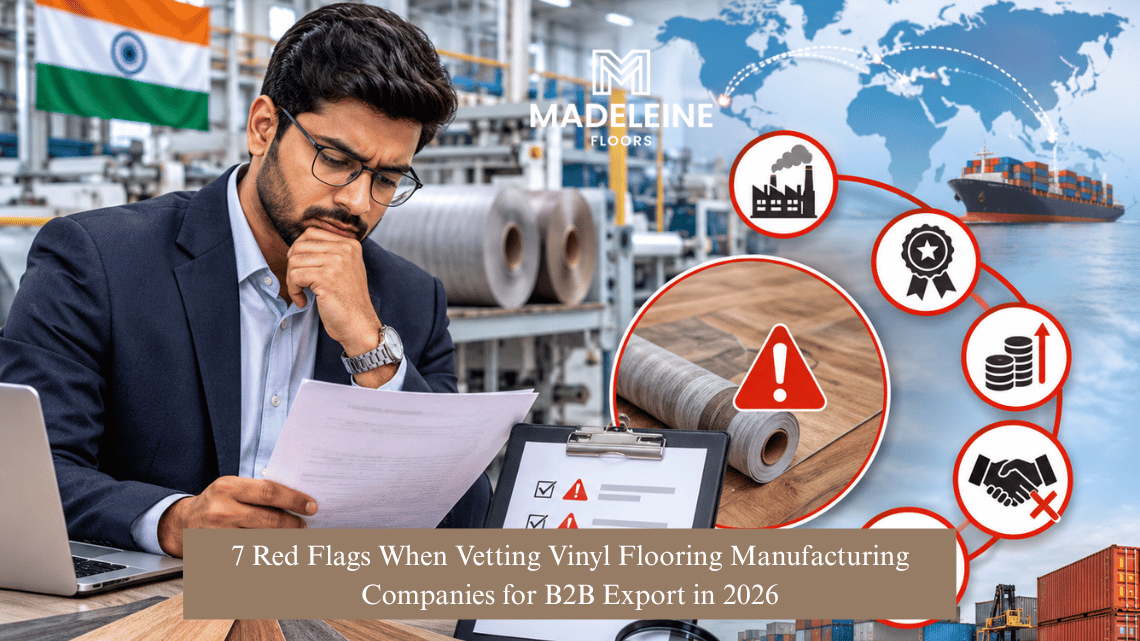
The demand for vinyl flooring is rising all over the world, and Indian manufacturers want to increase their market share. But choosing a manufacturing partner takes more than comparing rates and designs. A supplier can impress you on the first call and still let you down on quality, paperwork or delivery.
If you are searching for the best vinyl plank flooring manufacturers, look past the sales talk. Importers, distributors and contractors need proof, not promises. Here are seven red flags to check before you finalise anyone in 2026.
1. Missing Indian Standards & Fire Safety Compliance
Compliance always comes first. Safety rules need to be adhered to while using flooring in offices, hotels, and hospitals. In India, IS 3462:1986 covers unbacked flexible PVC flooring, and the National Building Code 2016 also refers to flooring materials.
One standard does not automatically cover every LVT or SPC product, so ask which standard applies to which range.
Warning signs:
- No test reports
- Fire claims without lab results
- Specs ignoring destination market
For export orders, ask for fire reports the importing country accepts, such as EN ISO 9239-1 or EN ISO 11925-2. A serious manufacturer explains this clearly and quickly.
2. No Proof of Eco-Friendly Vinyl & Indoor Air Quality (Low VOC)
Indoor air quality matters more every year. VOCs are chemicals that escape into the air from materials, adhesives and coatings.
Words like “green” or “non-toxic” mean nothing on their own. A supplier selling eco-friendly vinyl should back it up with documents, especially for office and healthcare projects in Australia or Europe.
Ask for:
- Low-VOC test reports
- FloorScore or similar certificates
- Raw material details
- Recycling practice details
If the claims cannot be explained or documented, treat that as a warning sign.
3. Unclear Wear Layer Thickness & Durability Ratings
The wear layer is the clear top surface that fights scratches and stains. A good manufacturer states its thickness plainly, in mm or microns. Thicker is not always better, though. The material, surface treatment and test results matter too.
Use matches differently. Homes, retail stores and busy hotels each need a different specification.
Red flags:
- No wear layer figure
- Plank and wear layer confused
- No abrasion test data
- Durability claims, no reports
Request samples and technical data sheets before a bulk order, then compare them against your project needs.
4. Limited Knowledge of Luxury Vinyl Tile (LVT) & Stone Plastic Composite (SPC)
Not all vinyl planks are manufactured the same way. LVT is quite flexible and can imitate the look of real wood or stone. SPC has a rigid core of mineral filler and PVC, which gives it a firmer feel and better dimensional stability.
A good supplier recommends one or the other based on your application. If they cannot explain the core composition, locking system or installation needs, be careful.
Other features you should find in quality vinyl plank flooring:
- Consistent plank sizes
- Reliable locking systems
- Proper installation instructions
5. Inconsistent Manufacturing Quality and Batch Variations
A sample can look perfect while the bulk shipment shows colour, thickness or finish differences. That creates installation trouble and complaints, especially when you supply several sites.
Ask the factory:
- Do you inspect regularly?
- Are tolerances monitored?
- Is every batch checked?
- Can you share inspection records?
If you plan repeat orders, ask for samples from different production batches. Good manufacturers follow written quality procedures instead of relying only on a visual check.
6. Weak Production Capacity and Unreliable Export Documentation
Quality is not worth much if the factory cannot deliver on time. This inconveniences the importers or contractors who have a schedule.
Confirm if the factory can accommodate your quantity of goods, and also ask for previous export destinations and packaging specifications.
Red flags are:
- Unclarity of capacity
- Unclarity of lead times
- Lack of experience in exports
- Lack of documentation for proper labelling
- No process to claim damages
For business-to-business buyers, communication and delivery are just as important as the product itself.
7. No Clear Warranty, After-Sales Support or Technical Assistance
The job of a manufacturer is not over once the container leaves the manufacturing plant. There will always be distributors or contractors that require assistance in installation, maintenance, warranty claims, and replacement.
However, if the supplier dodges these issues before the contract is signed, he might vanish after the payment. These matters should be sorted out:
- Coverage under warranty and exceptions
- Replacement clause
- Installation advice
- Availability of support
- Time taken to address complaints
It should be all written down in a contract for both parties.
Common Mistakes to Avoid When Selecting Vinyl Flooring Manufacturers
Even experienced buyers make mistakes in supplier checks.
- Picking suppliers by price alone: Low prices always mean some compromise on materials and quality checks.
- Sampling acceptance without testing: A nice looking product doesn’t guarantee quality and safety.
- Destination requirements ignored: Indian standards may be enough for all export destinations.
- Consistency ignored: Consistency is one of the reordering factors.
- Skipping written agreements: Record specifications, delivery, payment terms and warranty.
FAQs
1. How to select the best manufacturers of vinyl plank flooring in India?
Their capacity, specifications, quality control, certifications, experience in exporting and after-sales services need to be assessed. Always read all technical documents carefully before placing an order.
2. What certifications do B2B buyers have to consider?
It depends on the product and destination. Look for applicable BIS standards, fire test reports, relevant ISO or EN results and recognised low-VOC certificates.
3. What is the difference between LVT and SPC flooring?
The flexibility and versatility are the advantages of LVT. The SPC has a mineral-filled core that differs from LVT in many characteristics.
4. What does the wear layer thickness have to do with vinyl flooring?
It is the part that protects the floor from all the wear, scratches and damage. The wear layer thickness is to be chosen according to its usage.
5. Are Indian manufacturers able to satisfy the international B2B requirements?
Yes, many Indian manufacturers have already done this. But still verify their production capacity, exporting documents, destination, packaging and delivery.
Conclusion
Selecting a flooring supplier is not just about evaluating quality, standards, uniformity, and suitability for export; these are all critical elements that should be considered simultaneously. These seven warning signs will help importers and distributors find reliable flooring suppliers.
When searching for the best vinyl plank flooring manufacturers, pay attention to the technical parameters and reliability, not prices.
Contact the people from Madeleine Floors to discuss your needs regarding the floorings that you would need for your upcoming B2B project.